This picture from “Uxbridge The Good Old Days” is what the business looked like in 1975 before moving from downtown.
In 1947 Alex Williamson purchased the Imperial Oil station located at the corner or Brock Street East and Main Street and opened his Chevrolet-Oldsmobile dealership. Williamson was located at this corner for more than 30 years. To make room for his growing business Williamson moved his dealership south of downtown along highway 47. To serve the Uxbridge and surrounding areas they operated 2 locations. The Chevrolet-Oldsmobile at 259 Toronto Street South and the Pontiac-Buick-GMC at Douglas Road. In 2010 the franchise agreements for Pontiac dealers expired. Williamson closed the Douglas Road location and moved their Buick and GMC sales to the Toronto St location.
Williamson now serves Uxbridge out of 3 locations.
The Williamson Chevrolet, Cadillac, Buick and GMC dealership located to 259 Toronto St S
The Williamson Chrysler dealership located at 253 Toronto St S
The Williamson Certified used car dealership located at 1 Banff Rd
This picture from “Uxbridge The Good Old Days” shows the building at the corner of Brock St E and Main St after renovations in 1955
This photo shows the corner of Brock St E and Main St as it looks today (2021)
This photo taken in 2021 is their Toronto St S (Hwy 47) location.
This photo from 2020 is the Williamson Certified location on Banff Rd (formerly Canadian Tire)
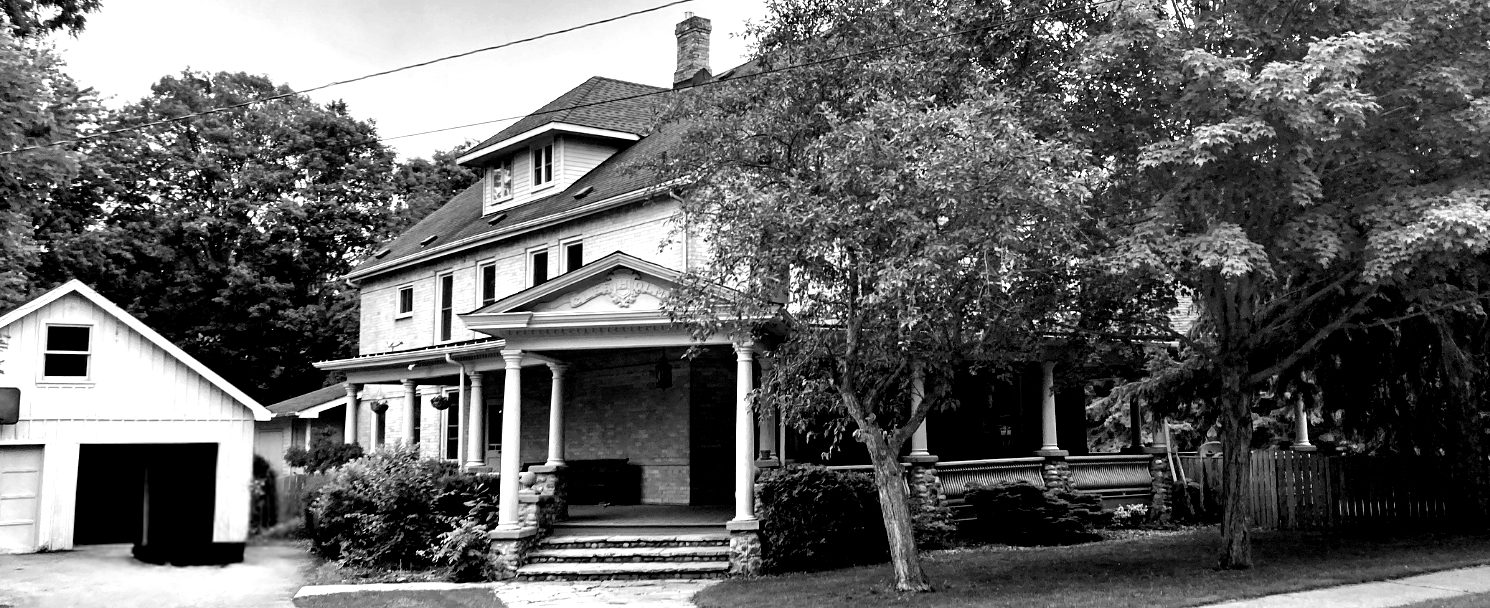
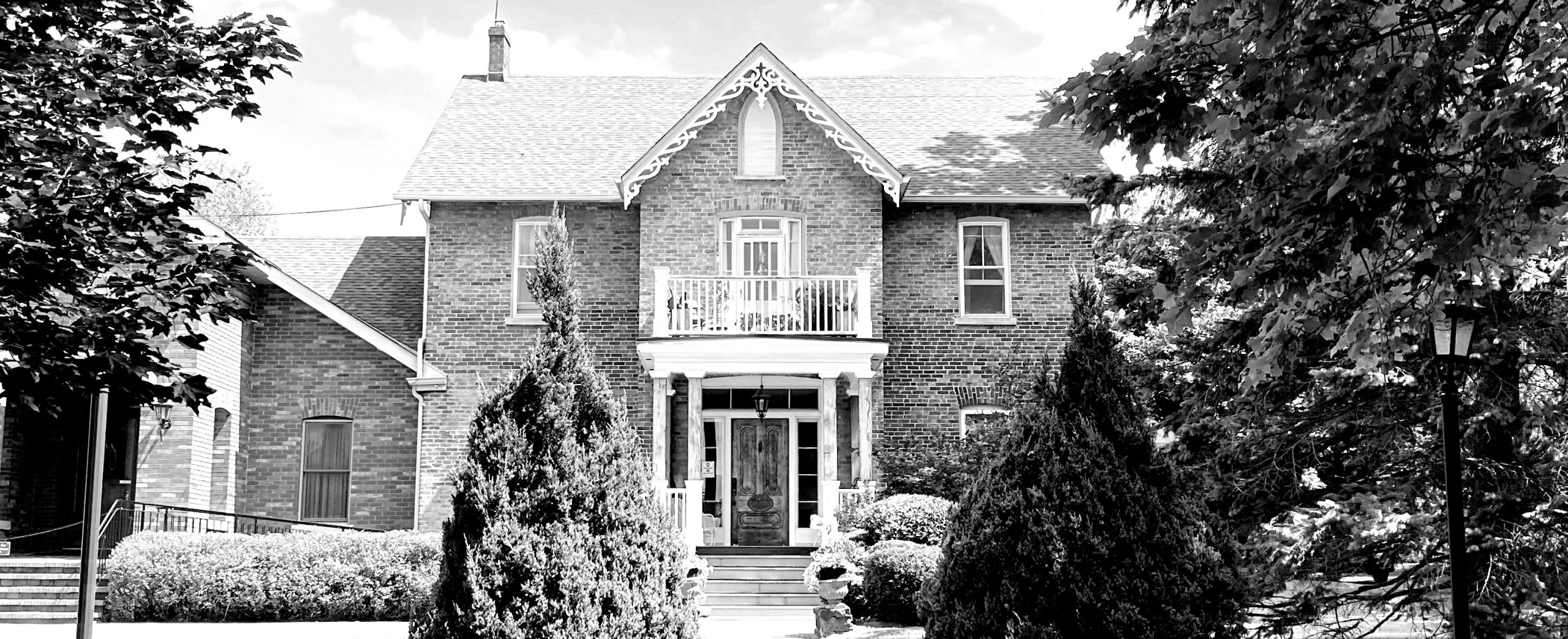
The Brownscombe Residence – “Gleeholme” at 32 Franklin Street, Uxbridge
Nestled along one of Uxbridge’s quieter residential streets, the home at 32 Franklin Street—known historically as Gleeholme—is an architectural and cultural treasure. Built in the early 20th century, the house carries with it a story rooted in music, craftsmanship, and small-town enterprise.
Brownscombe Residence “Gleeholme” 2021
A Musical Beginning: The Charles Small Era
The home was constructed around 1901 by Charles Small, the head of the Uxbridge Piano and Organ Company. Known for his expertise in fine musical instruments, Small brought the same attention to detail and artistry into the construction of his personal residence.
Some of the interior woodwork in Gleeholme is said to mirror the designs found on organs and pianos made by his company, and it’s likely that the lumber used in the home came directly from the factory. Small’s musical roots are embedded in the very structure of the home.
Gleeholme: A House with a Mysterious Name
Charles Small gave his home the name “Gleeholme,” though the exact origin of the name remains unknown. The word “glee” suggests joy or music, possibly nodding to Small’s musical background, while “holme” typically refers to a small island or riverside meadow—perhaps a romantic flourish to match the home’s character.
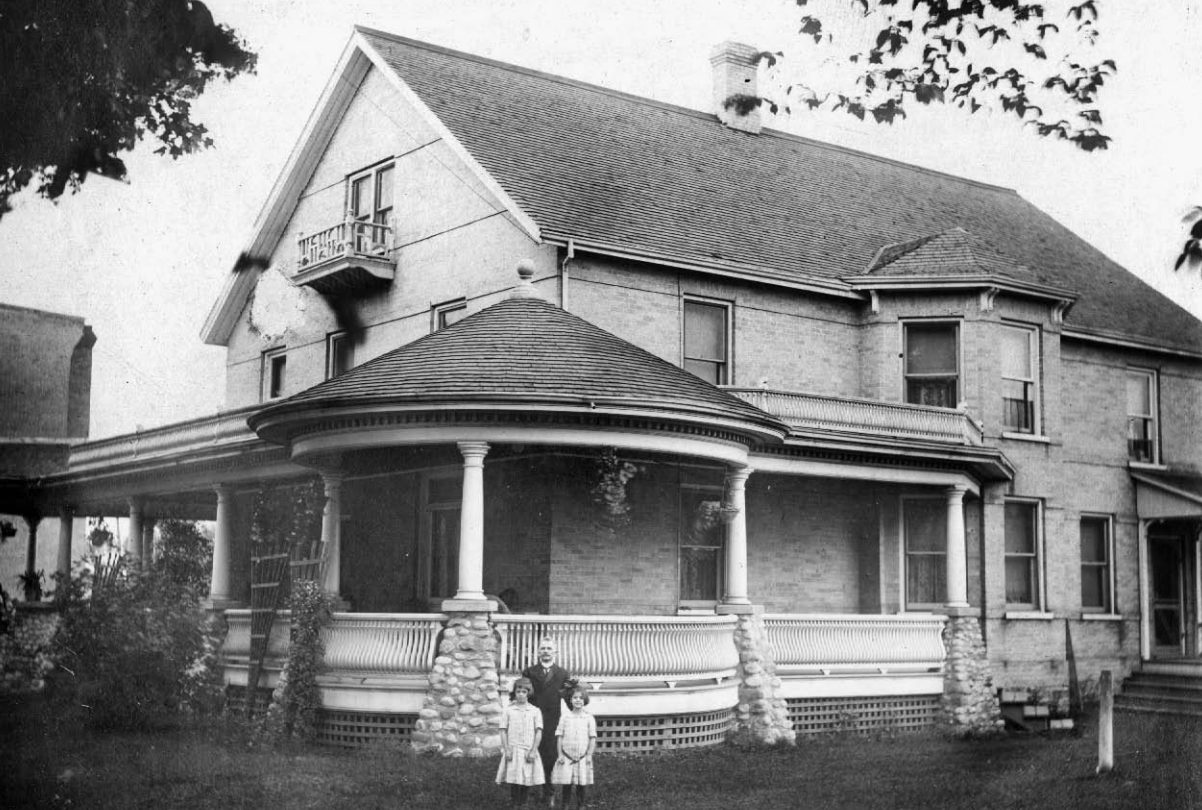
Brownscombe Residence “Gleeholme” – Southwestern view of Gleeholme taken in the early 1900’s after the verandah was added.
Architectural Features of Note
Gleeholme is a standout example of early 20th-century residential design. Notable architectural elements include:
A wraparound corner verandah, perfect for enjoying warm summer evenings.
A charming Juliet balcony, adding a touch of romantic elegance.
Dentil moulding beneath a massive pedimented entrance, contributing to the home’s stately façade.
These features make Gleeholme one of the most visually distinctive historic homes in Uxbridge.
Brownscombe Residence “Gleeholme” 2021
The Brownscombe Legacy
In 1907, Charles Small sold the home to J.F. Brownscombe, a prominent and respected Uxbridge merchant. Under his ownership, the home gained one of its most iconic features: the large verandah, which wraps around the front corner of the house. This addition not only enhanced the home’s beauty but also turned it into a neighbourhood landmark.
The Brownscombe family resided here for many years, and the home’s name and character became closely tied to their legacy in Uxbridge.
A Local Landmark
Today, the Brownscombe Residence remains a cherished part of Uxbridge’s architectural heritage. Its unique blend of musical history, elegant design, and community legacy continues to captivate residents and visitors alike. Whether admired during a heritage walking tour or simply appreciated on a stroll down Franklin Street, Gleeholme stands as a graceful tribute to the town’s creative and enterprising spirit.
Sources:
Uxbridge – Scugog Historic Homes & Historical Buildings
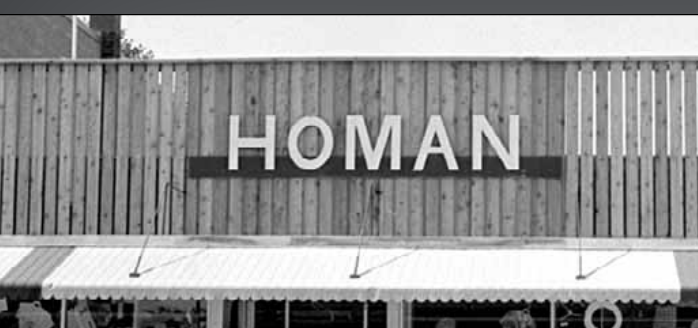
In the late 1960’s Homan’s department store opened at this location.
Every long time resident of Uxbridge will remember when 43 Brock St W was at it’s glory.
In the late 1960’s Homan’s department store opened at this location. I’m sure I am not the only one who remembers going shopping at Homan’s for their back to school clothing. The building later became home to (famous to Uxbridge) Ballinger’s Better Buy. Ballinger’s at the time was the local version of BiWay meets the present day dollar store. The building was later home to La Petite Fleur florists.
The building was constructed on the site of the former Uxbridge Fire Department, which at the time had become an eyesore in the downtown.
It is ironic that this building, once a busy part of our downtown has been vacant for many years and has once again become an eyesore.
Credit – UXBRIDGE The Good Old Days, by: J. Peter Hvidsten
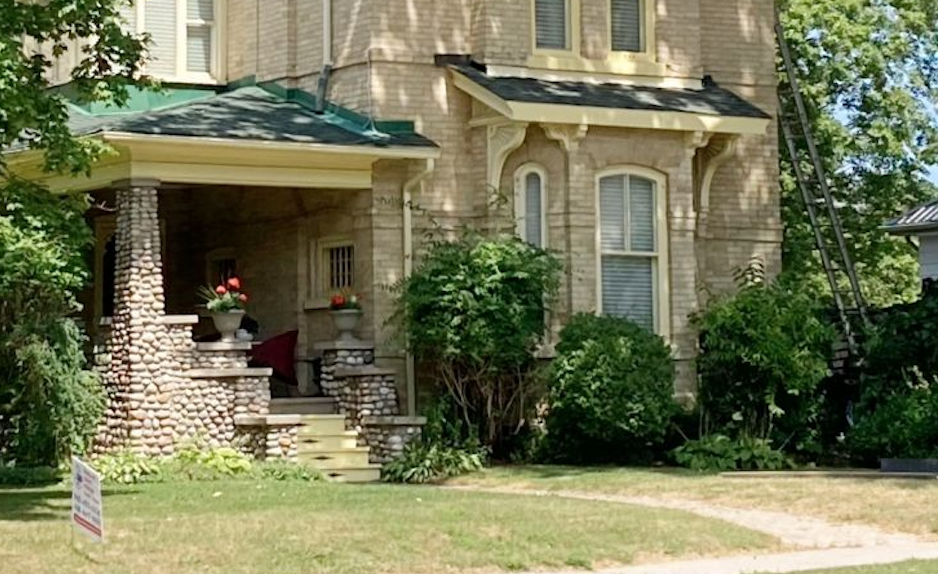
According to the Historic Homes and Heritage Buildings the earliest recorded owner of the property at the corner or Brock Street East and First Avenue was Wm T. Mason. In 1882 Mr. Mason sold the property to a veterinarian named A.H Badgerow. There was an old railway-house on the property which A.H Badgerow tore down to build the house we see here today.
Mr. Badgerow had a successful veterinarian practice but in 1887 he sold it to W.M Plank and his home to John R. Dales.
Nestled in the heart of Uxbridge, the John P. Plank Residence stands as a reminder of one of the town’s most influential early settlers. Built in 1874, the home is a testament to the legacy of John P. Plank, a man whose contributions helped shape the foundation of the community we know today.
John P. Plank Residence in 1972
John P. Plank arrived in Uxbridge in 1826 and quickly established himself as a cornerstone of early development. That same year, he built the town’s first inn and tavern, providing a much-needed stop for weary travelers. Just two years later, in 1828, Plank expanded his ventures by constructing a sawmill at Elgin Pond and opening Uxbridge’s first general store. His entrepreneurial spirit played a vital role in laying the groundwork for commerce and industry in the young town.
In the 1840s, Plank constructed a new inn just north of where the Uxbridge Music Hall now stands. Notably, it was the first brick building in Uxbridge—a clear sign of the town’s growth and Plank’s forward-thinking nature. He also acquired 200 acres east of Main Street, which he subdivided and sold off in the 1850s, contributing significantly to the town’s residential expansion.
By the 1870s, Plank turned his attention to a prime location at the southwest corner of Brock and Main Streets, where he built the Plank House—a structure that became a local landmark until it was later lost to fire. Tragedy struck again in 1873, when a devastating fire swept through the block between Marietta and Brock Streets, destroying multiple buildings, including Plank’s original home, once regarded as one of the finest in Uxbridge.
Determined to rebuild, the current John P. Plank Residence was constructed shortly after the fire. Sadly, Plank passed away in 1876, with his wife following just a year later. The home remained in the Plank family until 1934, when it was sold to Hartley Vyvyan. Two years later, it returned to the family line when Anson T. Button Jr., Plank’s grandson, purchased the house in 1936. Button converted the residence into apartments and lived there until his death in 1969.
Today, the home lives on as part of the Low and Low Funeral Home, now owned by the Low family. A significant addition was made to accommodate its current use, but the spirit of the original structure—and the pioneering man behind it—remains a notable part of Uxbridge’s story.
To learn more about the historic Plank House once located at Brock and Main Streets, visit our earlier post: Brock Street Uxbridge.
The John P. Plank house as it looks today as Low and Low Funeral Home
The John P. Plank house as it looks today as Low and Low Funeral Home
This housing report for Township of Uxbridge includes the number of new listings, average list price, number of properties sold, average selling price, average days on market and average asking price to selling price ratio for all property types within the Township of Uxbridge.
Scroll to the bottom for links to take you to the housing market reports for Durham, Scugog, Brock and the Kawartha Lakes.
Toronto Regional Real Estate Board
From Toronto Regional Real Estate Board
Toronto Regional Real Estate Board – Market Stats At A Glance – June 2023
This housing report for Township of Scugog includes the number of new listings, average list price, number of properties sold, average selling price, average days on market and average asking price to selling price ratio for all property types within the Township of Scugog.
Scroll to the bottom for links to take you to the housing market reports for Durham, Uxbridge, Brock and the Kawartha Lakes
Toronto Regional Real Estate Board
TRREB Housing Market Charts June 2023
Toronto Regional Real Estate Board – Market Stats At A Glance – June 2023
This housing report for Township of Brock includes the number of new listings, average list price, number of properties sold, average selling price, average days on market and average asking price to selling price ratio for all property types within the Township of Brock.
Scroll to the bottom for links to take you to the housing market reports for Durham, Uxbridge, Scugog and the Kawartha Lakes.
Toronto Regional Real Estate Board
From Toronto Regional Real Estate Board
Toronto Regional Real Estate Board – Market Stats At A Glance – June 2023
This housing report for Kawartha Lakes includes the number of new listings, average list price, number of properties sold, average selling price, average days on market and average asking price to selling price ratio for all property types within the Kawartha Lakes.
Scroll to the bottom for links to take you to the housing market reports for Durham, Uxbridge, Scugog and Brock.
Toronto Regional Real Estate Board
From Toronto Regional Real Estate Board
Toronto Regional Real Estate Board – Market Stats At A Glance – June 2023
This housing report for Durham Region includes the number of new listings, average list price, number of properties sold, average selling price, average days on market and average asking price to selling price ratio for all property types within the Region of Durham.
Scroll to the bottom for links to take you to the housing market reports for Uxbridge, Scugog, Brock and the Kawartha Lakes.
Toronto Regional Real Estate Board
From Toronto Regional Real Estate Board
Toronto Regional Real Estate Board – Market Stats At A Glance – June 2023
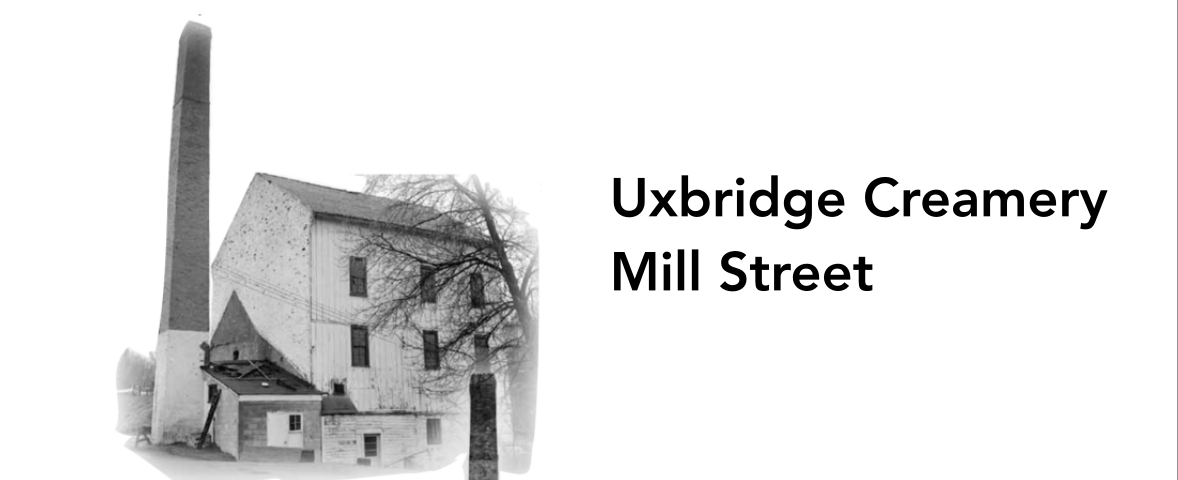
The history of Uxbridge is filled with buildings and landmarks that, while no longer standing, left a lasting impact on the community. One such piece of local history is the Uxbridge Creamery.
Seen here is the Uxbridge Creamery at Toronto Street South and Mill Street. The building was located just down the hill on Mills St on the north side.
From Wool to Cream
The building that would eventually become known as the Uxbridge Creamery was originally constructed around 1886 by Joseph Gould and his son. Located on the north side of Mill Street, just east of Toronto Street, the Goulds first operated a successful wool-spinning business here. For many years, this industry supported both the Gould family and the growing Uxbridge community.
By the 1920s, the building had taken on a new purpose. Believed to have been converted into a creamery around this time, it quickly became an important part of daily life in Uxbridge. Creameries were central hubs for processing milk into butter, cream, and cheese—essentials for local families and businesses alike.
It is believed sometime around the 1920’s the building was converted into a creamery.
The creamery is shown here as it was being torn down in 1972.
The End of an Era
The Uxbridge Creamery served the town for decades before its doors finally closed. In 1972, the building itself was torn down, marking the end of an era. Yet, the tall brick chimney remained standing long after the creamery was gone, serving as a recognizable landmark for local residents who remembered its role in the community.
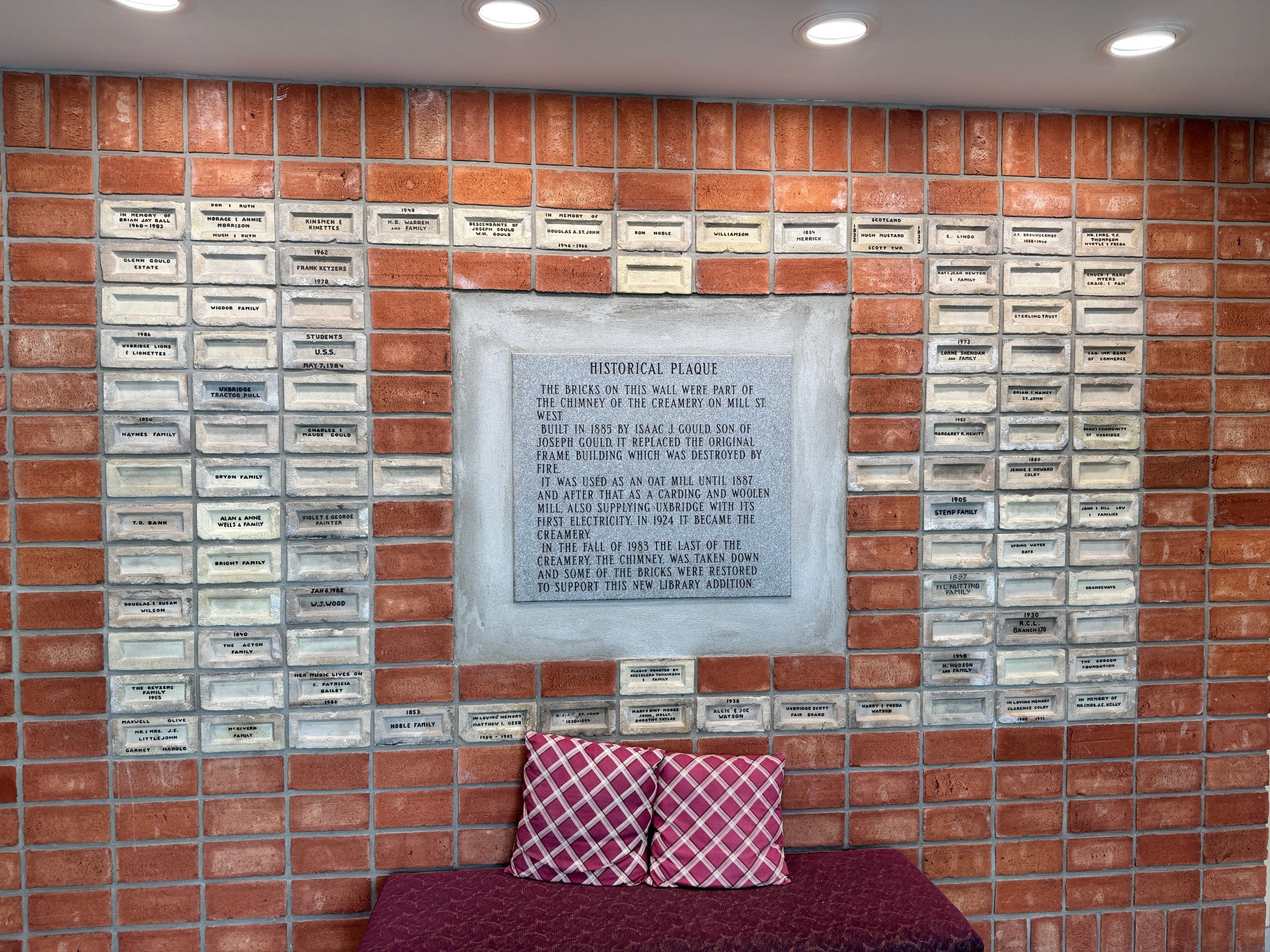
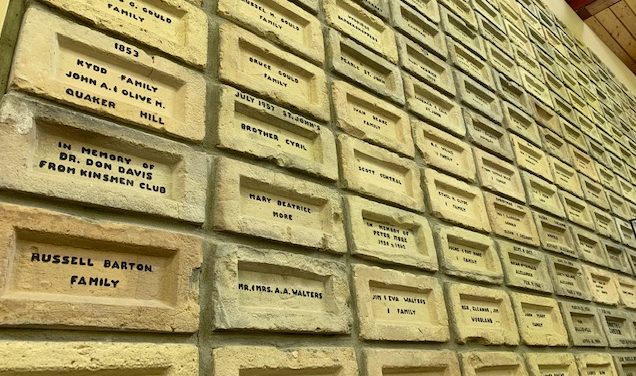
Eventually, the chimney, too, was taken down. But in true Uxbridge spirit, the memory of the creamery was not lost. When the chimney was demolished, the bricks were made available for purchase. Families could inscribe their names or dedicate them in memory of loved ones. These personalized bricks were then used to create a commemorative wall at the Uxbridge Public Library—a lasting tribute to the creamery and the generations of residents who were connected to it.
The approximate location of the chimney before it was demolished.
The photo above shows the approximate location of the chimney before it was demolished to make room for the house we see there today.
Though the Uxbridge Creamery no longer stands, its story lives on. From its origins with Joseph Gould to its years as a thriving creamery, and finally through the legacy wall at the library, it continues to be part of Uxbridge’s shared history.
The chimney may no longer tower over Mill Street, but the memories—and the bricks—ensure that the Uxbridge Creamery remains woven into the fabric of our town’s past.
Old Creamery Photos courtesy of: Uxbridge The Good Old Days by: J. Peter Hvidsten
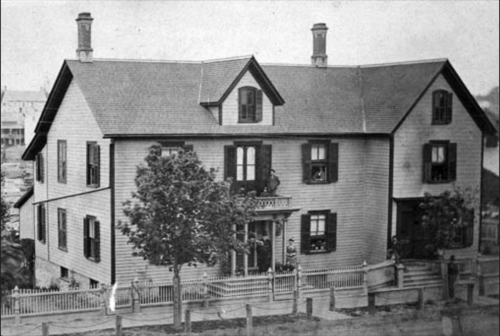
This photo shows the house after it had a full second storey and addition added to the north in around 1880. Photo courtesy of Uxbridge The First 100 Years by: J. Peter Hvidsten
The Dr. Mellow – Dr. Bascom House was built by Dr. Bascom around 1863 after he graduated from medical school and started his practice in Uxbridge.
The house was originally built as a one and half storey with a gable above the front door. The Bascom house at this time had some detailing around the front entrance with a porch above but lacked the decorative trim typically found on homes built in this era.
The original 1 1/2 storey Bascom House.
Around 1880 the Dr. Mellow – Dr. Bascom House was renovated to make room for Dr. Bascom’s growing practice. A complete second storey and an addition for his office to the north were added.
This photo shows the Bascom House after the addition to the north and the complete second storey were added. Photo courtesy of Uxbridge – Scugog Historic Homes and Heritage Buildings by: Paul Arculus J. Peter Hvidsten
In 1892 Dr. Bascom moved to Toronto and left the practice to his nephew Dr. Horace Bascom. Dr. Horace continued to practice out of the house until he sold the property to Dr. Frank Mellow, who took over in 1912. Dr. Mellow would then go on to service the Uxbridge community for over 50 years.
Dr. Mellow – Dr. Bascom House. Photo courtesy of Uxbridge – Scugog Historic Homes and Heritage Buildings by: Paul Arculus J. Peter Hvidsten
Dr. Mellow passed away in 1963 at the age of 89 leaving behind his wife and two children.
Dr. Mellow – Dr. Bascom House
For many years the property was owned and maintained by members of the Mellow family.
Even though the house is almost 160 years old, it is still one of the most decorative and attractive homes in Uxbridge.
Dr. Mellow – Dr. Bascom House as seen today (2021)
If you would like to learn more about this home or other historic homes in uxbridge visit the:
Safeguarding and Presenting Your Home While on Vacation
Maximizing Sale Potential
As exciting as vacations can be, it’s crucial not to overlook the safety and presentation of your home while you’re away. Selling your home can be a stressful process, especially when you’re away on vacation. However, it’s crucial to prioritize the safety and presentation of your property even when you’re not around. Protecting your property from potential intruders and maintaining its curb appeal can help ensure peace of mind and even maximize its value. In this blog post, we will discuss effective ways of Safeguarding and Presenting Your Home While on Vacation to showcase it at its best while you’re away during the listing period.
In this blog post, we will discuss effective ways to protect your home and showcase it at its best while you’re away on vacation during the listing period.
Work with a Trusted RealEstate Agent
Choose a reliable and experienced real estate agentwho understands your concerns about home security and presentation. Ensure that your agent is well-versed in managing properties while the owners are away. They can provide guidance, implement necessary precautions, and coordinate with other professionals to maintain your home’s safety and appeal.
As part of our comprehensive services, we offer pre-showing and post-showing visits to your home to ensure it looks its absolute best and remains secure. Prior to each day’s showings, our team will visit your home to ensure that all lights are turned on, creating a warm and inviting atmosphere that showcases your property’s finest features. Additionally, after the final showing of the day, we will return to your home to ensure all lights are switched off and your property is securely locked. With our attentive care, you can rest assured that we will ensure the safeguarding and presenting of your home while you are on vacation.
Invest in a Security System
One of the best investments you can make to safeguard your home is a comprehensive security system. Consider installing surveillance cameras, motion detectors, and an alarm system to deter potential intruders. Nowadays, many advanced security systems offer remote access, allowing you to monitor your home from anywhere in the world using your smartphone or laptop.
There are also many DIY home security cameras that offer remote viewing capabilities on your smartphone or tablet providing added peace of mind while you’re away. Numerous options are available in the market, ranging from wireless indoor cameras to weatherproof outdoor cameras. These cameras are easy to install and connect to your home Wi-Fi network, allowing you to view live video feeds and receive notifications of any activity detected at your home. With just a few taps on your smartphone or tablet, you can keep an eye on your property from anywhere, enhancing the security of your home even when you’re not physically present.
There are also many DIY home security cameras that offer remote viewing capabilities
Notify Trusted Neighbours or Friends
Informing trustworthy neighbours or friends about your absence is an excellent way to keep an extra pair of eyes on your property. They can help monitor any suspicious activities, collect mail or packages, and they can ensure that everything is in order and report any issues or concerns to your real estate agent. This person can also help maintain the curb appeal of your property by keeping the exterior tidy, mowing the lawn, and watering plants.
Arrange for Regular Maintenance
Consider scheduling regular maintenance services while you’re away. Arrange for lawn care, snow removal (if applicable), and house cleaning services to give your home a well-kept appearance. An unkempt exterior can signal vacancy to potential burglars, while a well-maintained home demonstrates your commitment to upkeep and can leave a lasting impression on potential buyers.
Use Timers for Lighting
Keep your home well-lit to discourage burglars. Invest in light timers or smart lighting systems that can automatically turn on and off at specific times. Program your lights to mimic your usual routines, such as turning on in the evening and turning off in the morning. Smart timers, accessible through your smartphone or tablet, offer the convenience of remotely controlling your lights and devices to create the illusion of an occupied home, allowing you to turn them on and off at desired intervals as if you were there.
Pause Deliveries and Mail
A pile of uncollected mail or packages is an obvious indication that nobody is home. Temporarily suspend regular mail delivery and any subscriptions you receive. Alternatively, you can ask a neighbour or friend to collect your mail regularly. This way, your home won’t appear vacant, reducing the chances of break-ins.
Canada Post has a Hold Mail service that temporarily stops mail delivery at your address when you’re not there to receive it. Your mail is safely stored at a Canada Post facility until your return.
Temporarily suspend regular mail delivery and any subscriptions you receive.
Keep Social Media Posts Limited
While we all want to share vacation updates on social media, it is advisable to avoid oversharing details about your absence. Publicly posting about your vacation plans and the duration of your absence can unknowingly attract unwanted attention. Restrict your posts to a select group of trusted friends or wait until you return to share your vacation memories.
Publicly posting about your vacation plans and the duration of your absence can unknowingly attract unwanted attention.
Secure Doors and Windows
Before leaving for your vacation, double-check that all doors and windows are securely locked. Install deadbolts on exterior doors for added security. Reinforce glass sliding doors with a metal bar or install a security film to make them more resistant to break-ins. Secure basement windows and any other vulnerable access points to prevent unauthorized entry.
Limit Personal Items and Valuables
Before you leave for vacation, remove or secure valuable and personal items. Store important documents, jewelry, and valuable electronics in a safe or lockbox.
Clearing your home of excessive personal items is essential when preparing it for showings, as it creates a blank canvas that enables potential buyers to envision themselves living in the space. By removing personal items such as family photos, unique memorabilia, and personalized decor, you create a neutral environment that appeals to a wider range of buyers. Additionally, reducing the presence of valuable personal items minimizes the risk of theft or accidental damage during showings, providing both peace of mind and a more secure atmosphere for potential buyers to explore your home.
Store important documents, jewelry, and valuable electronics in a safe or lockbox.
Stage Your Home Professionally
Consider hiring a professional home stager to showcase your property’s best features while you’re on vacation. Staging a home plays a crucial role in the successful sale of a property. It involves strategically arranging furniture, decor, and accessories to showcase the home’s best features and create an inviting atmosphere for potential buyers. A well-staged home allows buyers to visualize the full potential of the space and helps them connect emotionally with the property. It highlights the property’s unique selling points, maximizes its appeal, and increases its perceived value. Staging also helps create a sense of scale, improves flow, and emphasizes functionality, making the home more marketable. With the help of a staging expert, your home will continue to make a positive impression on prospective buyers, even in your absence.
A well-staged home allows buyers to visualize the full potential of the space and helps them connect emotionally with the property.
Inform Your Real Estate Agent
Keep your real estate agentwell-informed about your vacation plans and duration. Share your contact information and emergency contact details with them. This ensures that they can reach you promptly if necessary and that they can stay informed about the status of your property during your absence. If you have a neighbour helping to look after your property, share their contact information as well. For minor issues this could eliminate the need to interrupt your vacation unnecessarily.
Selling your home while you’re away on vacation doesn’t have to be a cause for concern. By implementing these strategies, you can rest assured that we will ensure the safeguarding and presenting of your home while you are away. Collaborating with a trusted real estate agent, installing a security system, enlisting the help of a reliable neighbour or friend, and maintaining regular maintenance are essential steps to protect your home. Additionally, professional staging and safeguarding valuables contribute to creating a welcoming and secure environment for potential buyers. With these precautions in place, you can enjoy your vacation while confidently knowing that your home is in good hands and continues to shine in your absence.
The History of Sacred Heart Roman Catholic Church in Uxbridge
The story of the Sacred Heart Roman Catholic Church in Uxbridge is one of faith, perseverance, and devotion — a journey that began in the homes of early settlers and grew into one of the town’s most cherished spiritual landmarks.
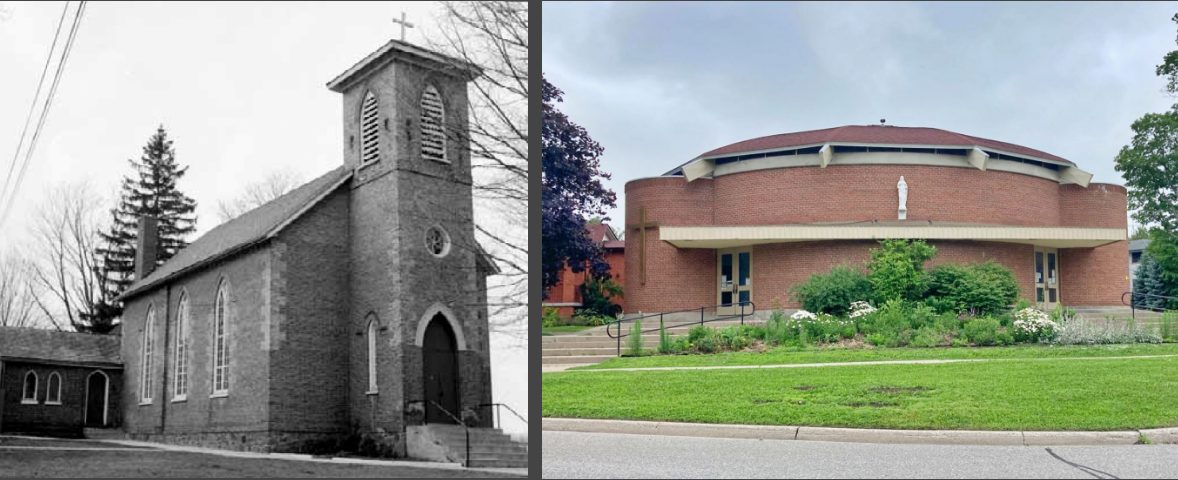
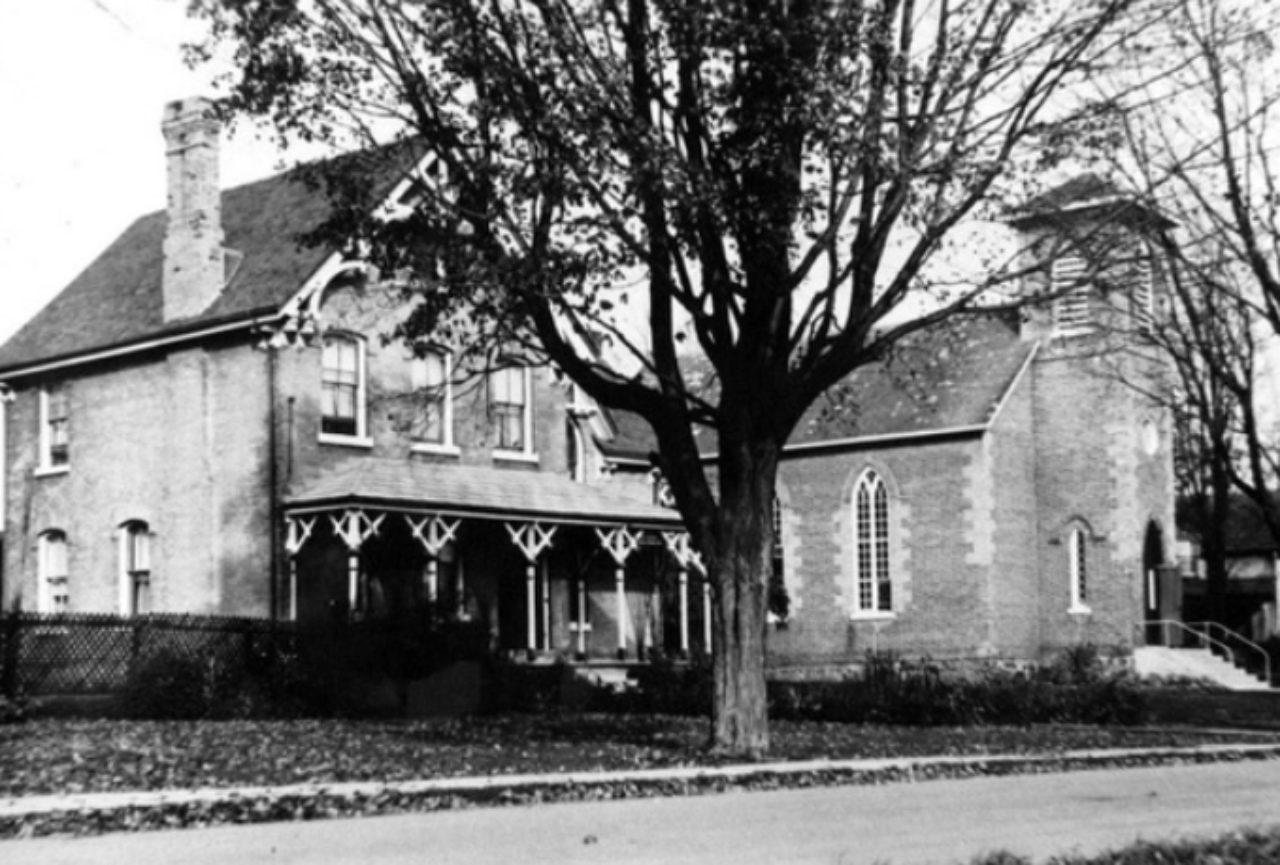
The Sacred Heart Church which was built in the late 1800’s at 70 Toronto St N. Photo Courtesy of Uxbridge The Good Old Days by: J. Peter Hvidsten
Humble Beginnings (Before 1865)
Before a church was ever built, Uxbridge’s early Roman Catholic families gathered for Mass in the home of Michael O’Neill, located near the site of what is now the CIBC on Brock Street. These small, heartfelt gatherings kept the faith alive until the growing Catholic community could build a proper place of worship.
The First Church: Sacred Heart of Jesus (1864–1883)
Construction on Uxbridge’s first Catholic Church began in 1864 on Toronto Street North, and the first Mass was celebrated there on February 3, 1865. The new church was named “The Sacred Heart of Jesus”, and its total cost — including furnishings — came to $2,000, a significant investment for the small congregation.
A two-storey rectory, built in 1874, was added just south of the church to house the parish priest. A rectory is the priest’s residence, typically located on church grounds, serving as both a home and a place for parish administration.
In 1883, Reverend Luke Allain purchased a bell for the church tower with financial help from members of all faiths in Uxbridge. In return, he promised to ring the bell three times a day — a role that had previously been filled by the town’s fire hall bell before it was destroyed in a fire.
By 1881, Catholics still made up a small fraction of Uxbridge’s population — only about 20 parishioners — but their commitment was unwavering.
The demolition on the church in progress, September 1963. Photo Courtesy of Uxbridge The Good Old Days by: J. Peter Hvidsten
Years of Growth and Service (1886–1959)
Between 1886 and 1950, 25 Roman Catholic priests served the Uxbridge congregation, each helping to nurture and strengthen the community’s faith.
In the late 1940s, efforts were made to bring an Order of Sisters to Uxbridge. Between 1948 and 1950, the Order of Sisters of the Sacred Heart established a convent in the former Gould home on Toronto Street. However, in 1958, the Sisters moved to Alexandra, and the vacant house unfortunately became a target for vandals two years later.
In April 1953, under the guidance of Rev. John Karskens, the Catholic Women’s League (CWL) was established, providing parishioners with a strong network for charitable works, fellowship, and service to the church.
Then in 1959, Rev. Andrew Marynen became pastor and began plans to construct a new church to replace the aging original building, which was nearing a century old and no longer met the needs of the growing congregation.
The New Church: A Fresh Beginning (1963–1964)
In September 1963, the historic original church was demolished to make room for the new Sacred Heart Church. While construction was underway, services were temporarily held in the chapel at St. John Training School from August 1963 to May 1964.
The first Mass in the new building took place on June 5, 1964, led by Rev. Andrew Marynen, and the solemn blessing and official opening were held on Sunday, July 26, 1964, at 4:00 p.m. with His Grace, the Most Reverend Philip F. Pocock, Archbishop of Toronto, officiating the ceremony.
A Modern Design for a Modern Era
The new Sacred Heart Church featured a distinctive semi-circular design, with the west side connecting to a large parish hall. The layout offered excellent visibility from two angled rows of pews facing the altar. Inside, a vaulted ceiling, tall grey arches, and rows of stained-glass windows created a serene and uplifting atmosphere for worship.
Faith and Dedication Through the Years
Over the decades, Sacred Heart parishioners have continuously enhanced the church through their time, talent, and devotion. One of the most notable additions is the Grotto dedicated to Mary, located on the front lawn — a peaceful outdoor space for prayer and reflection, lovingly built and maintained by the community.
A Lasting Legacy
For more than 160 years, the Sacred Heart Roman Catholic Church has been a cornerstone of faith in Uxbridge. From humble beginnings in a family home to the beautiful modern church that stands today, it remains a symbol of the town’s enduring spirit, unity, and faith.
To learn more about Uxbridge’s historic buildings, churches, and the stories behind them, visit Explore Uxbridge — your guide to discovering the heart and history of our community.
35 Toronto Street North, Uxbridge ON, Built in 1878. Photo courtesy of Uxbridge The Good Old Days by: J. Peter Hvidsten
35 Toronto Street North, Uxbridge ON
Built in 1878
The George Wheler Residence was once described as “the most commanding public residences in Uxbridge” by Francis Keller – publisher of the Uxbridge Times-Journal (1978)
Photos taken in 1959 shows the home as it was seen from the intersection of Toronto Street and Brock Street.
The above photos taken in 1959 shows the home as it was seen from the intersection of Toronto Street and Brock Street before it was surrounded by other buildings.
Photo – 2022. Currently it is divided into apartments.
In 1885 George Wheler left town and the home was sold. Since then the property has seen many different owners. Currently it is divided into apartments.


 Facebook
 X
X
 Pinterest
 Copy Link