This housing report for the Township of Brock includes the number of new listings, average list price, number of properties sold, average selling price, average days on market and average asking price to selling price ratio for all property types within the Township of Brock.
Scroll to the bottom for links to take you to the housing market reports for Durham Region, Uxbridge, Scugog and the Kawartha Lakes
Toronto Regional Real Estate Board
From the Toronto Regional Real Estate Board – Market Watch Report – January 2023
This housing report for the Township of Scugog includes the number of new listings, average list price, number of properties sold, average selling price, average days on market and average asking price to selling price ratio for all property types within the Township of Scugog.
Scroll to the bottom for links to take you to the housing market reports for Durham Region, Uxbridge, Brock and the Kawartha Lakes
Toronto Regional Real Estate Board
From the Toronto Regional Real Estate Board – Market Watch Report – January 2023
Toronto Regional Real Estate Board – Market Stats At A Glance – January 2023
This housing report for the Township of Uxbridge includes the number of new listings, average list price, number of properties sold, average selling price, average days on market and average asking price to selling price ratio for all property types within the Township of Uxbridge.
Scroll to the bottom for links to take you to the housing market reports for Durham Region, Scugog, Brock and the Kawartha Lakes
Toronto Regional Real Estate Board
From the Toronto Regional Real Estate Board – Market Watch Report – January 2023
Toronto Regional Real Estate Board – Market Stats At A Glance – January 2023
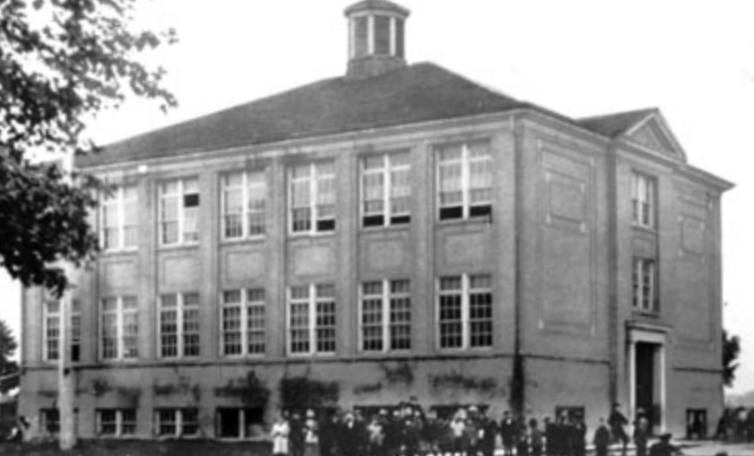
Uxbridge Public School – 1910. Photo courtesy of the Toronto Public Library
The Original Building
The photo above shows the original Public School on Victoria Drive in Uxbridge. According to the Uxbridge/Scott Museum files, land was acquired and a new brick school was built on the site of the present Uxbridge Public School.
Elementary students were located on the main floor with the high school students on the second floor.
This building became over crowed and in 1887 and a new high school was built on First Avenue. This new school opened to high school students in 1888 with the younger grades remaining in the school on Victoria Drive.
This school stood on this site from the 1870’s until it was destroyed by a fire in July 1910. Some works were doing some renovations to the school and had a fire going to heat some water. Sparks from the fire landed on the work shed that was attached to the school (see photo below) and before long the whole structure was on fire.
Back of the Public School, showing the wood shed that caught fire. Photo courtesy by Lynn Voisard
Uxbridge Public School, built in 1910. Photo courtesy the Uxbridge/Scott Museum.
New School
The new school built on the site of the original building was officially opened in October 1911. Until the new building was opened, classes were held in local church basements and vacant stores.
Additions
According to the Uxbridge/Scott Museum file the first addition to the school was officially opened in November 1955 and would held four new classrooms for grades 5 – 8.
The new addition to Uxbridge Public School opened in November 1955. Photo courtesy of Uxbridge The Good Old Days by: J. Peter Hvidsten Page 39.
View of the new addition with the original school in the back ground. Photo courtesy of Uxbridge The Good Old Days by: J. Peter Hvidsten Page 39
In November 1964 a second addition was added to the school. The new structure was added to the west and connected to the previous addition. This addition would feature 4 additional classrooms and the gymnasium-auditorium to the north.
Drawing courtesy of Uxbridge The Good Old Days by: J. Peter Hvidsten showing the proposed addition to the Public School. Page 135
More Photos
Provided by Uxbridge Public School
Uxbridge Public School 1973/74 school year
Uxbridge Public School 1964/65
Uxbridge Public School Now(2021)
Now the Uxbridge Public School serves a population of approximately 350 students in grades K-8 in the French Immersion Program.
Uxbridge Public School 2021
Uxbridge Public School 2021
My Public School History – Shane
I attended school here from Kindergarten to Grade 6. My grades 1-3 where in the original building with my grade 4 being in a portable and 5-6 where in the newer part.
The school has a large yard divided in the middle by a hill. The top portion nearest the school had a large hard top area, grass areas and a large playground. The bottom potion was the sports fields. Many winter recesses were spent tobogganing when the playground was covered in snow.
There are so many great memories growing up in this school. Memories from milk days, hot dog days, track and field, watching the train go by and having a Michael Jackson day where we watched his new Thriller video in the gym.
History of Uxbridge High School and Uxbridge Secondary School
Uxbridge High School – 1887
Uxbridge High School on First Avenue. Photo courtesy of the Scugog Heritage Gallery by: J. Peter Hvidsten
Uxbridge High School
In 1873 a school was built on the site of the current Uxbridge Public School. Elementary students were located on the first floor and high school students on the second floor.
In 1887, when this school became overcrowded a new High School (shown above) was built on First Avenue across from the Methodist Church (Trinity United Church). It opened to students in February 1888.
Uxbridge High School on First Avenue. Photo courtesy of the Scugog Heritage Gallery by: J. Peter Hvidsten
Uxbridge High School. Photo courtesy of Uxbridge The First 100 Years by: J. Peter Hvidsten Page 92
The Uxbridge High School became run down and was not capable of serving the needs of the growing community. The school would either have to be enlarged, redesigned or replaced. It was decided that the school would be replaced by a new building located at the corner of Third Avenue and Planks Lane.
History of Uxbridge Secondary School – 1923
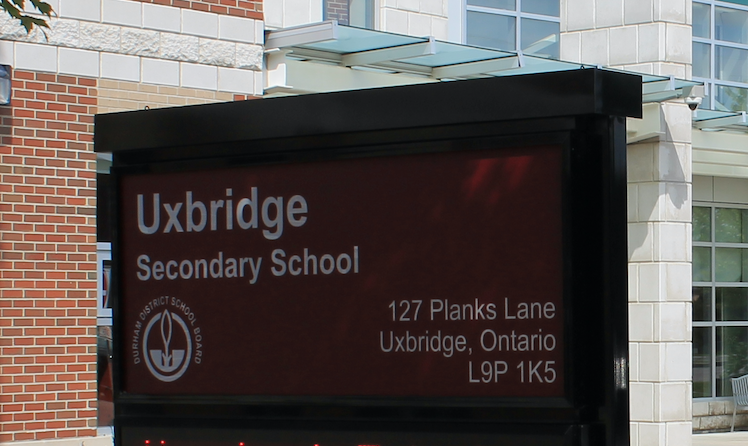
Uxbridge Secondary School – opened in April 1924. This photo is courtesy of Uxbridge The First 100 Years by: J. Peter Hvidsten – Page 168
The school was originally built in 1923 and was known as Uxbridge High School. It opened to student in April 1924.
Uxbridge High School under construction. The cornerstone for the school was laid on July 5, 1923 and was opened in April 1924. Photo courtesy of Uxbridge The First 100 Years by: J. Peter Hvidsten
Post Card of Uxbridge High School. Taken as construction was ending.
Additions
Since being built the school has seen five major additions. The first addition was in 1965 with others being added in 1979, 1985, 2003, and 2013.
Additions at Uxbridge Secondary School
Uxbridge Secondary School additions over the years.
The 1979 addition, which in this photo is hidden behind the 1965 addition added the former cafeteria, main office, the current gym and all the shops that existed up until 2003 addition.
Located at the corner of Planks Lane and Third Avenue South the school now serves students from grade 9 through 12. According the the Uxbridge Secondary School website the current school has 81 classrooms, two gymnasiums and a cafeteria and has a student population of 1020 with 84 teaching and support staff (September 2020).
Here we see the original Uxbridge Train Station in a photo taken shortly after it was built in 1870. A Toronto & Nipissing locomotive pulling a passenger train is about to stop at the station. Courtesy of the Port Perry/Scugog Township Heritage Gallery.
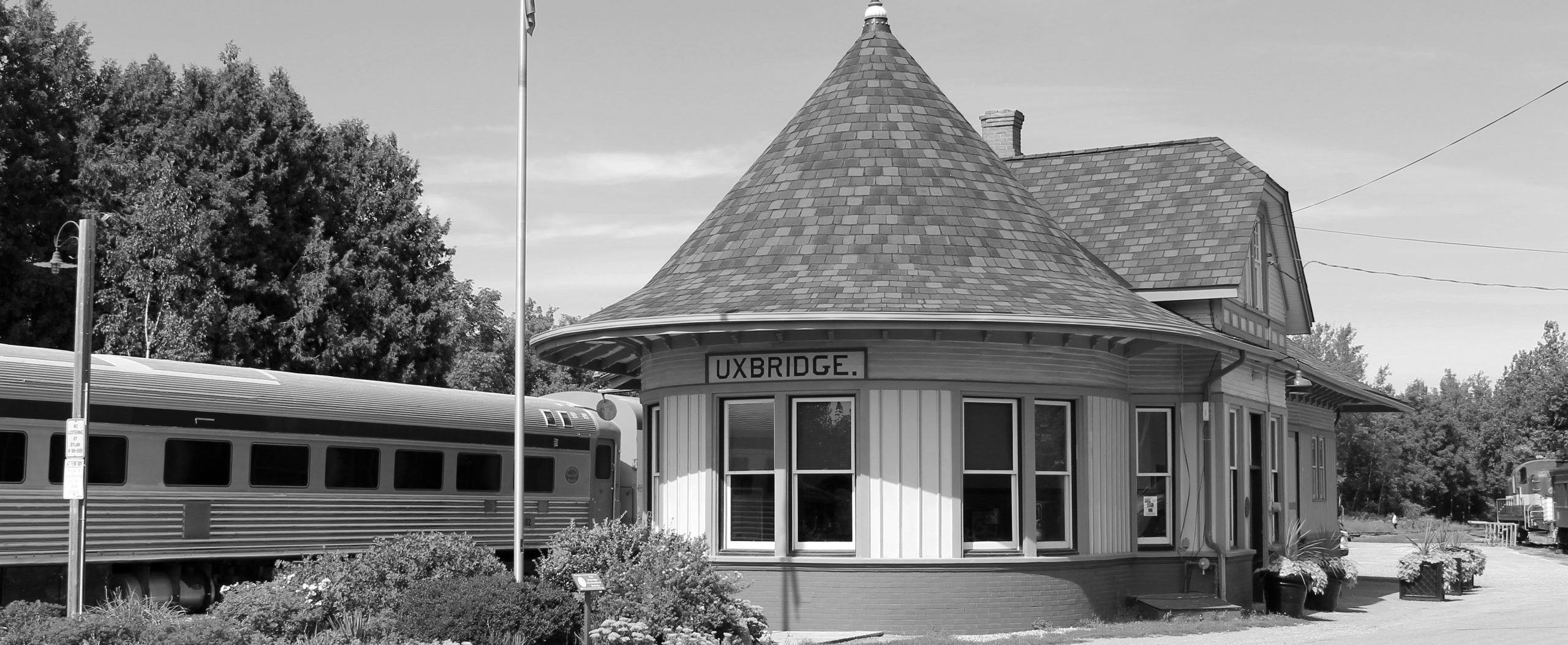
The Toronto & Nipissing Railway built the first Uxbridge station in 1870. For many years the station was operated by the Grand Truck Railway and in 1904 the station we know today with its “witch’s hat” roof was built, shown below.
The Witch’s Hat Station
Uxbridge station in May 1966. Courtesy of the Ingenium Digital Archives.
Uxbridge Railway Station with its most notable feature, the large “witch’s hat” roof above the circular waiting room in 1909. Photo courtesy of Uxbridge The First 100, Page 102 by: J. Peter Hvidsten
In this photo taken around 1900 looking north along Spruce Street we can see the Uxbridge Railway Station at the end of the street with the Revere House on the left. The Revere House hotel, which was conveniently located across from the train station was built in the 1870s by Fred Chinn. Photo courtesy of Uxbridge The First 100 Years, page 152, by: J. Peter Hvidsten
The Revere House hotel built by Fred Chinn in the early 1870s on Spruce St.,opposite the railway station. Photo courtesy of Uxbridge The First 100 Years, page 50, by: J. Peter Hvidsten.
The first passenger train came into town in 1871. In 1920s the line became part of the Canadian National Railway and serviced the town for many more years. In 1978 the station was closed to passengers while freight service continued until the 1980’s. Uxbridge received its last delivery of mail by train in April 1960 and on December 31 1961 the last passenger train passed through town. The tracks north of Uxbridge were removed and turned into part of the Trans-Canada Trial.
Uxbridge Train Station Today
This photo taken in 2020 shows the Uxbridge Train Station as it appears today.
The Township of Uxbridge purchased the station and was the home of the York-Durham Heritage Railway (YDR). From 1996 – 2023 the YDR operated the station and ran historical train rides between Stouffville and Uxbridge. The train brought tourists from all over to enjoy the train and our town. The YDR has had many popular events including A Day Out With Thomas, Harry Potter Themed Train and The Polar Express.
This housing report for the Kawartha Lakes Real Estate December 2022 includes the number of new listings, average list price, number of properties sold, average selling price, average days on market and average asking price to selling price ratio for all property types within the City of Kawartha Lakes.
Scroll to the bottom for links that take you to the housing market reports for Durham, Uxbridge, Scugog and Brock.
Kawartha Lakes Housing December 2022
New Listings
Average Asking Price
Number of Properties Sold
Average Selling Price
Average Days on Market
Average List Price to Sale Price Ratio
*Information is believed to be accurate at time of posting but is not guaranteed to be correct
Statistics are based on properties that have been listed and sold on the Toronto Regional Real Estate Board, properties not listed with TRREB will not be included in this report.
This housing report for Durham Region includes the number of new listings, average list price, number of properties sold, average selling price, average days on market and average asking price to selling price ratio for all property types within the Region of Durham.
Scroll to the bottom for links to take you to the housing market reports for Uxbridge, Scugog, Brock and the Kawartha Lakes
Toronto Regional Real Estate Board
From the Toronto Regional Real Estate Board – Market Watch Report – December 2022
Toronto Regional Real Estate Board – Market Stats At A Glance – December 2022
This report on Brock Real Estate includes the number of new listings, average list price, number of properties sold, average selling price, average days on market and average asking price to selling price ratio for all property types within the Township of Brock.
Scroll to the bottom for links to take you to the housing market reports for Durham, Uxbridge, Scugog and the Kawartha Lakes
Toronto Regional Real Estate Board
From the Toronto Regional Real Estate Board – Market Watch Report – December 2022
Toronto Regional Real Estate Board – Market Stats At A Glance – December 2022
This report on Scugog Real Estate includes the number of new listings, average list price, number of properties sold, average selling price, average days on market and average asking price to selling price ratio for all property types within the Township of Scugog.
Scroll to the bottom for links to take you to the housing market reports for Durham, Uxbridge, Brock and the Kawartha Lakes
Toronto Regional Real Estate Board
From the Toronto Regional Real Estate Board – Market Watch Report – December 2022
Toronto Regional Real Estate Board – Market Watch Report – December 2022
The photo above is a post card showing the view of the pond looking north from Main Street, taken in 1905. You can see the Oatmeal Mill at the north end of the pond beside the dam. If you look closely you can see the Library Tower and the Bell Tower on Toronto St. The photo below was taken in December 2021 showing the same view.
The above photo shows the Oatmeal Mill on the north end of the pond which was build by Isaac J. Gould in 1885. The building to the right of the mill is the Gould saw mill. The building to the left is the Oatmeal Kiln which is still standing today and has been converted to a home (shown below)
This photo shows the pond looking north towards Elgin Park from Mill Street. The docks in the above photo were located to left the of this photo.
Summer On The Pond
Through the 1950’s to 70’s Uxbridge residents cooled off in the waters of Elgin Pond during the hot summer months. Quite often children would first dunk themselves in the spring fed water trough and then jump in the pond. This would make the pond water feel warmer.
View of the dam and waterfall under Mill Street taken from the approximate location of the old beach and docks.
Winter on the Pond
Another memory of our youths is the “Old Man Winter” van on the ice (I believe it was called). They would place a van (stripped of all its parts of course) on the north end of the pond. You could purchase tickets and guess when you thought the van would fall through the ice. There was a clock mounted in the windshield that would stop the moment it hit the water. In the spring we would make mom and dad drive by everyday so we could see how far it had sunk into the ice until it was gone.
Elgin Pond in winter, viewed from Mill Street.
The above photo was taken just west of the dam. You can see the barricades that would keep skaters away from the thin ice near the dam. In winter sections of the pond are cleared for skating and hockey. The township monitors the ice safety using flags. A red flag means the ice is not safe to use, while a yellow flag means skate with caution.
Elgin Pond Today
Even though the pond has changed over the years and is not the swimming hole it used to be it still has its share of community fun. Every spring for the last 18 years it has been the location for the Huck Finn Youth Fishing Day and in the winter it becomes a favourite spot for a game of hockey or just some leisure family skating.
Poster advertising the 2022 Uxbridge Huck Finn Youth Fishing Days.
Below are some photos taken of the pond in the summer of 2020
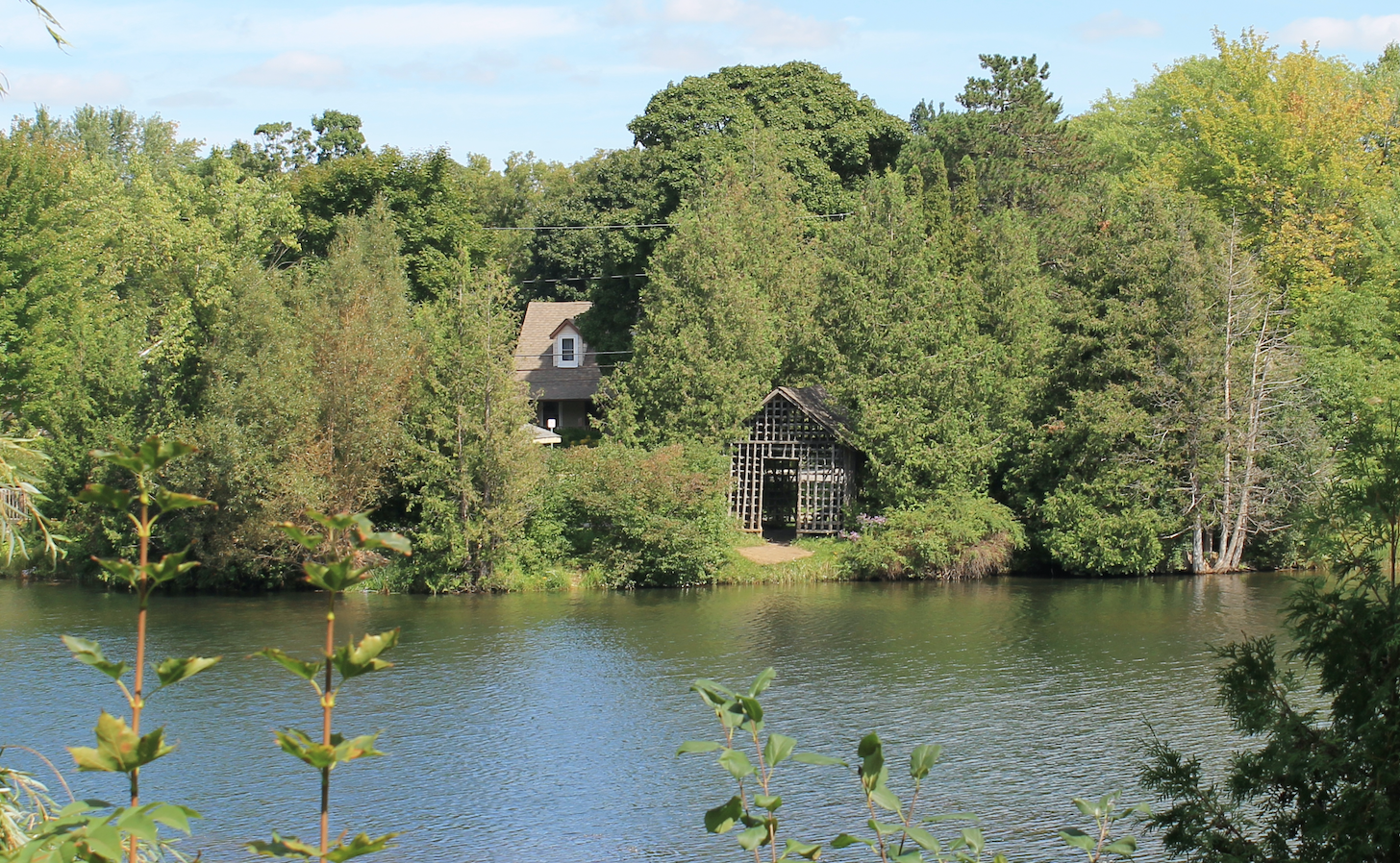
Looking across the pond from Main Street. This would have been the approximate location of the dock.
This housing report for Uxbridge includes the number of new listings, average list price, number of properties sold, average selling price, average days on market and average asking price to selling price ratio for all property types within the Township of Uxbridge
Scroll to the bottom for links to take you to the housing market reports for Durham, Uxbridge, Scugog and the Kawartha Lakes
Toronto Regional Real Estate Board
From the Toronto Regional Real Estate Board – Market Watch Report – December 2022
Toronto Regional Real Estate Board – Market Stats At A Glance – December 2022
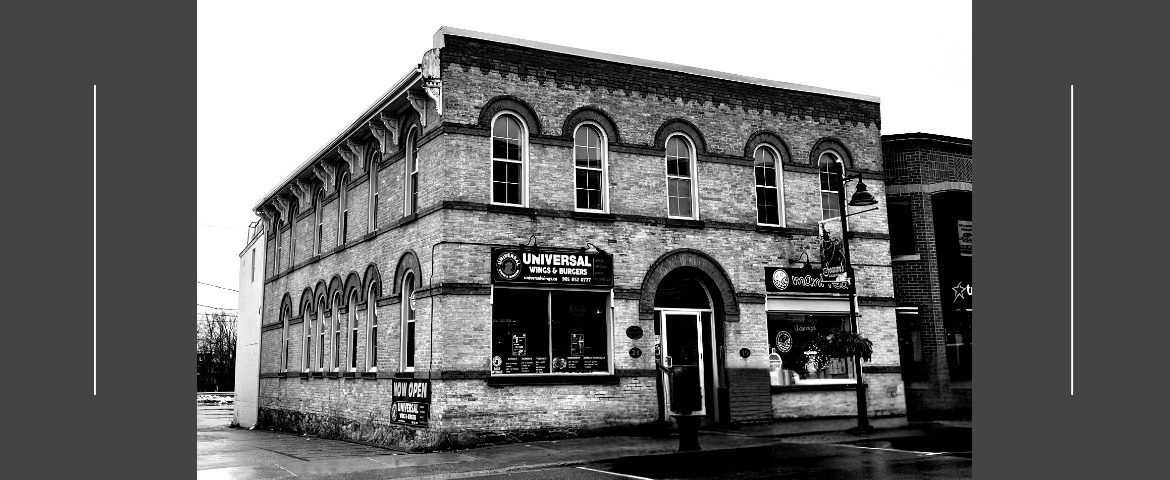
Standing at the intersection of Brock Street and Bascom Street, the Bascom House Hotel has been a quiet witness to over a century of change in downtown Uxbridge. Built in 1884, this distinctive building has worn many hats—beginning as a hotel, evolving into a bustling newspaper office, transforming into a local restaurant and inn, and now serving as a home to modern-day retail and residential tenants.
.
The above photo (date unknown) shows the Bascom House when it was operated as a hotel. Photo Credit: Uxbridge The First 100 Years by: J. Peter Hvidsten
A Hotel with Prime Real Estate
Strategically located on the north side of Brock Street, where it meets Bascom Street, the Bascom House was ideally situated to welcome visitors arriving by stagecoach or, later, rail. Its doors first opened in 1884, offering weary travelers a place to rest and recharge in the heart of a growing town. For over three decades, it operated as a hotel, becoming a familiar sight to residents and newcomers alike.
Photo Credit: Uxbridge The First 100 Years by: J. Peter Hvidsten
Photo courtesy of J. Peter Hvidsten
The Press Moves In
In 1920, the building transitioned from hospitality to headlines. Harold Cave, owner of The North Ontario Times, purchased the Bascom House and moved his printing presses and editorial offices into the space. A decade later, in 1930, Cave acquired the Uxbridge Journal and merged the two newspapers to form the Uxbridge Times-Journal. Under his stewardship, the paper thrived, becoming the voice of the community until Cave sold it in 1951 to Per and Leila Hvidsten.
The Times-Journal continued to operate from the old Bascom House until November 1957, when it moved to a new location at 20 Bascom Street. For the first time in nearly 75 years, the building sat empty.
.
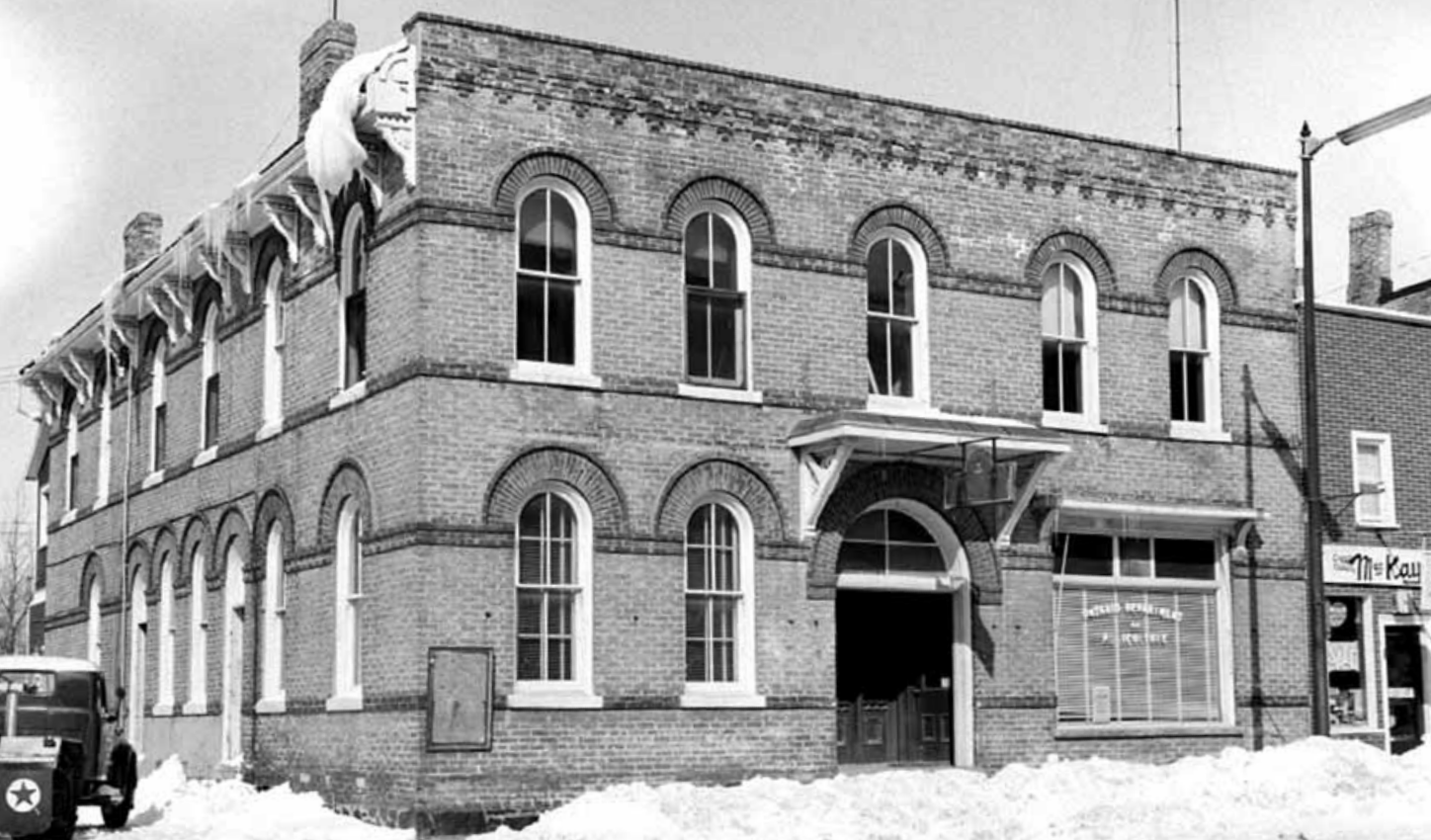
The above photo courtesy of Uxbridge The Good Old Days by: J. Peter Hvidsten shows the building in 1954 when it was the home of the Uxbridge Times-Journal.
A New Chapter: Evelyn’s Grill and Hotel Evelyn
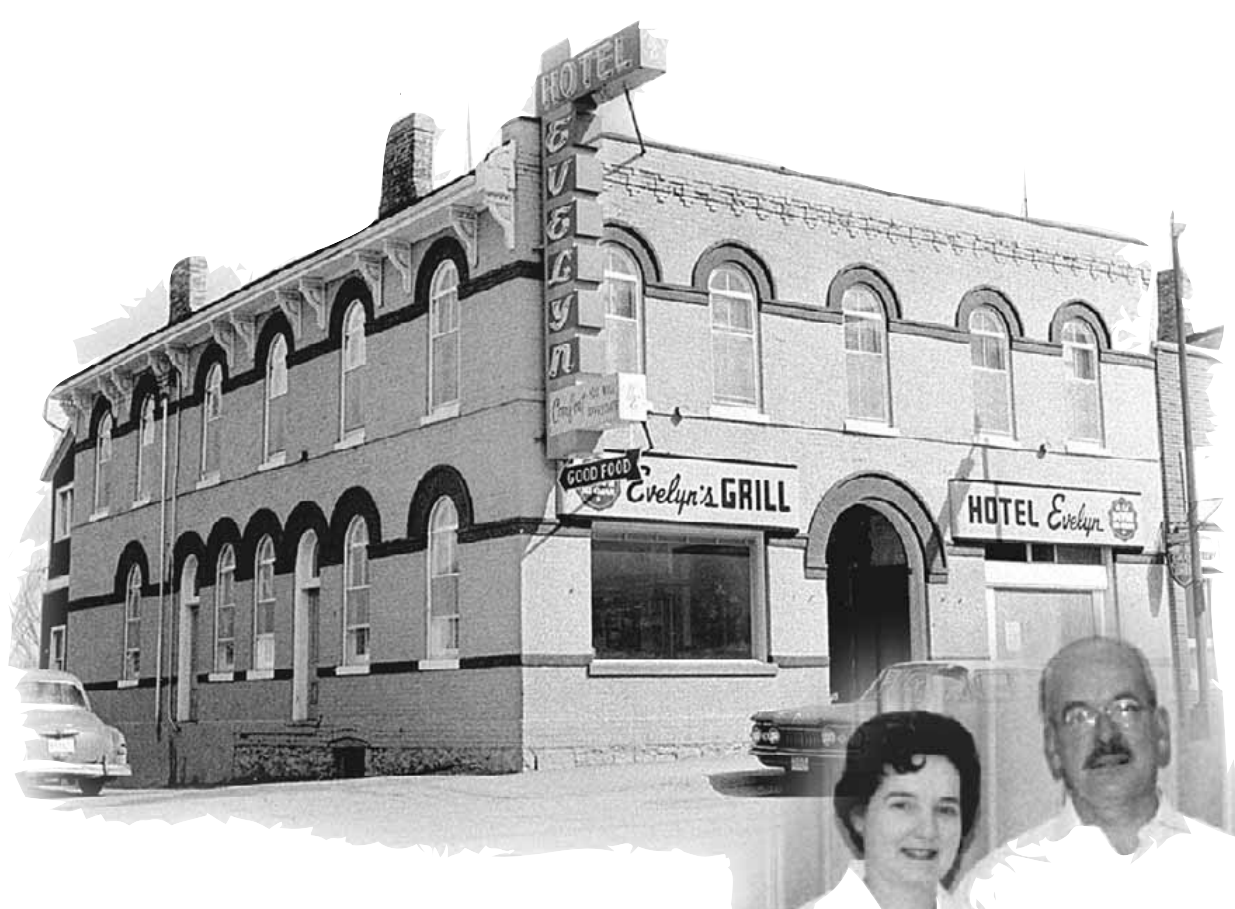
In the early 1960s, Jack and Evelyn Morrison saw potential in the dormant building. They purchased the property and breathed new life into the main level with Evelyn’s Grill, a cozy local restaurant. By 1960, they had also transformed the upper floor into four guest rooms, reopening the building as Hotel Evelyn—an echo of its original purpose.
.
Jack and Evelyn Morrison (shown above) where the owners of the Hotel Evelyn and Evelyn’s Grill. Photo courtesy of Uxbridge The Good Old Days by: J. Peter Hvidsten
Photo Credit: Uxbridge The First 100 Years by: J. Peter Hvidsten
A Legacy of Change
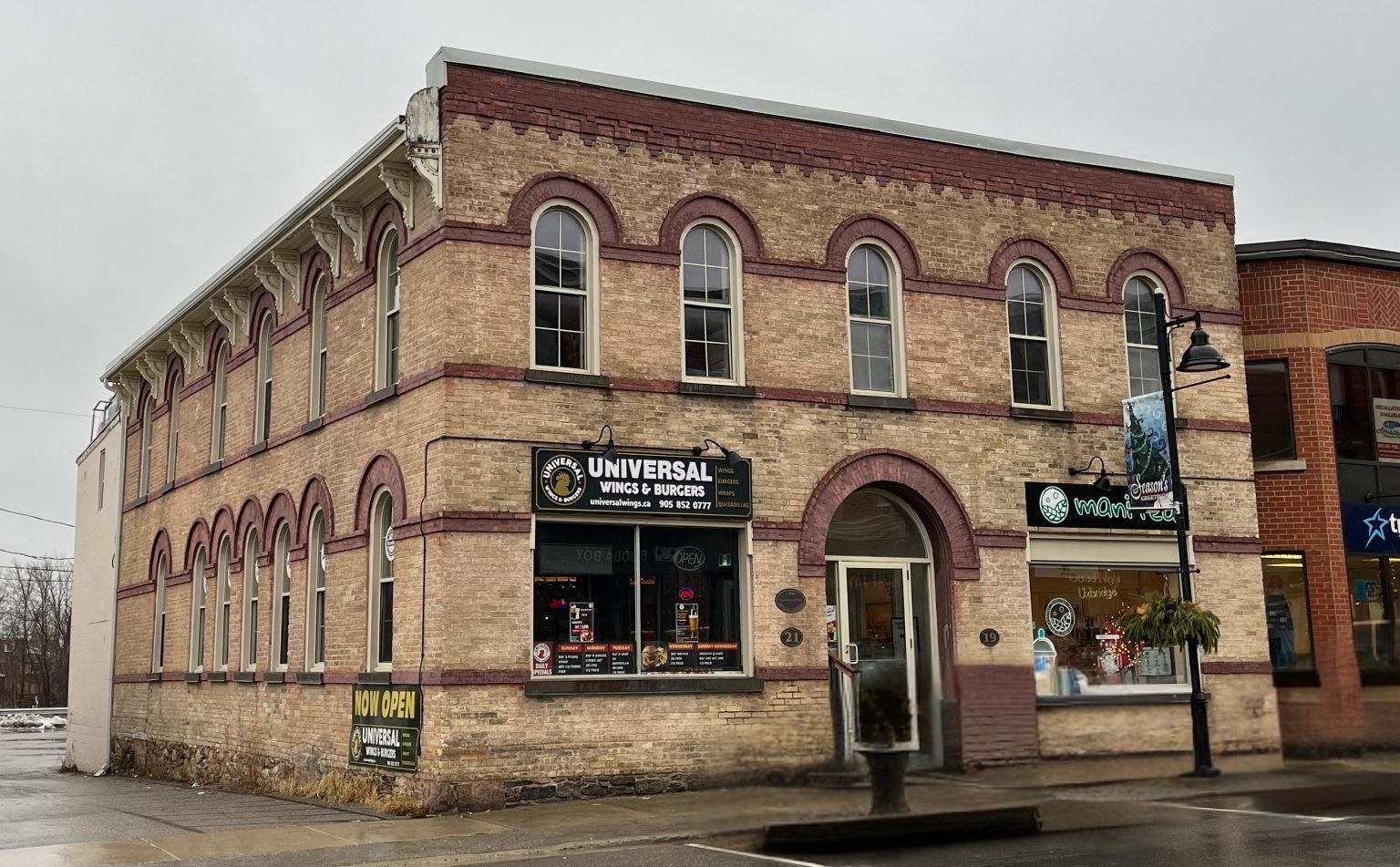
Like many buildings in Uxbridge’s historic core, the Bascom House has adapted to the times. Over the decades, a number of businesses have come and gone, each adding a new layer to its storied past. Today, the upper floor houses apartments while the main level is home to two retail spaces, continuing its legacy as a vibrant part of the community.
While it no longer serves guests checking in for the night or churning out newspaper headlines, the Bascom House remains a proud fixture in Uxbridge. Its ability to evolve with the needs of the town is a testament to the enduring character of this historic building.
.
The Bascom House/Hotel as it is seen today. Photo was taken in January 2023
Heritage Uxbridge plaque on the outside of the building
The Changing Face of a Corner — Brock Street West and Spruce Street, Uxbridge
.
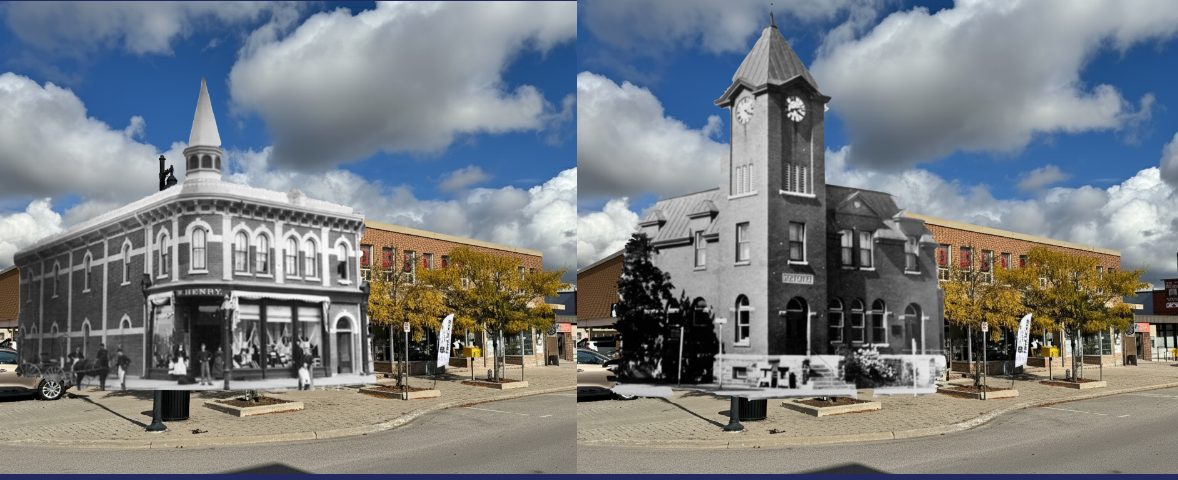
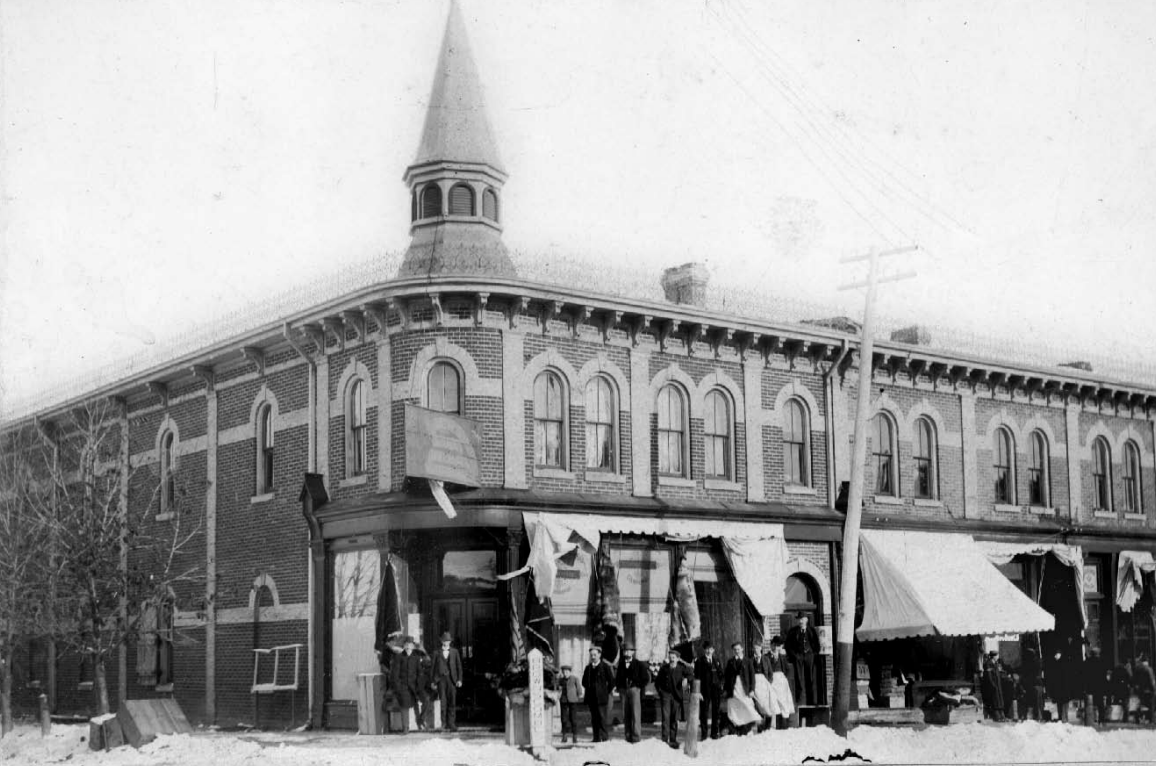
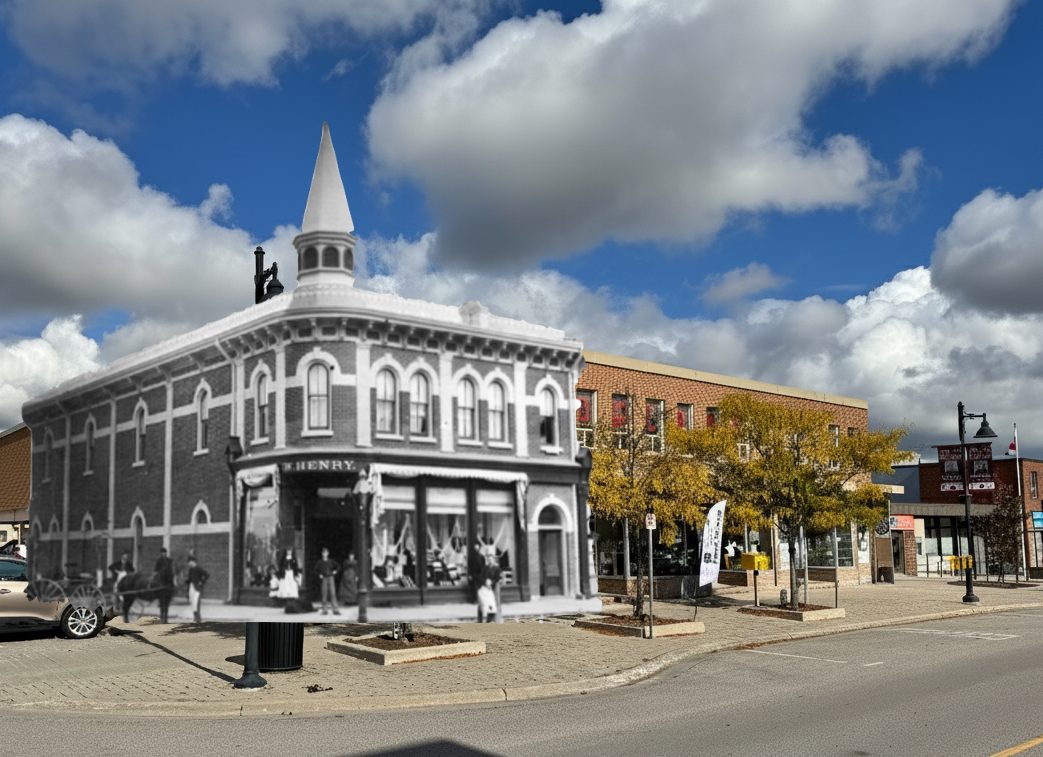
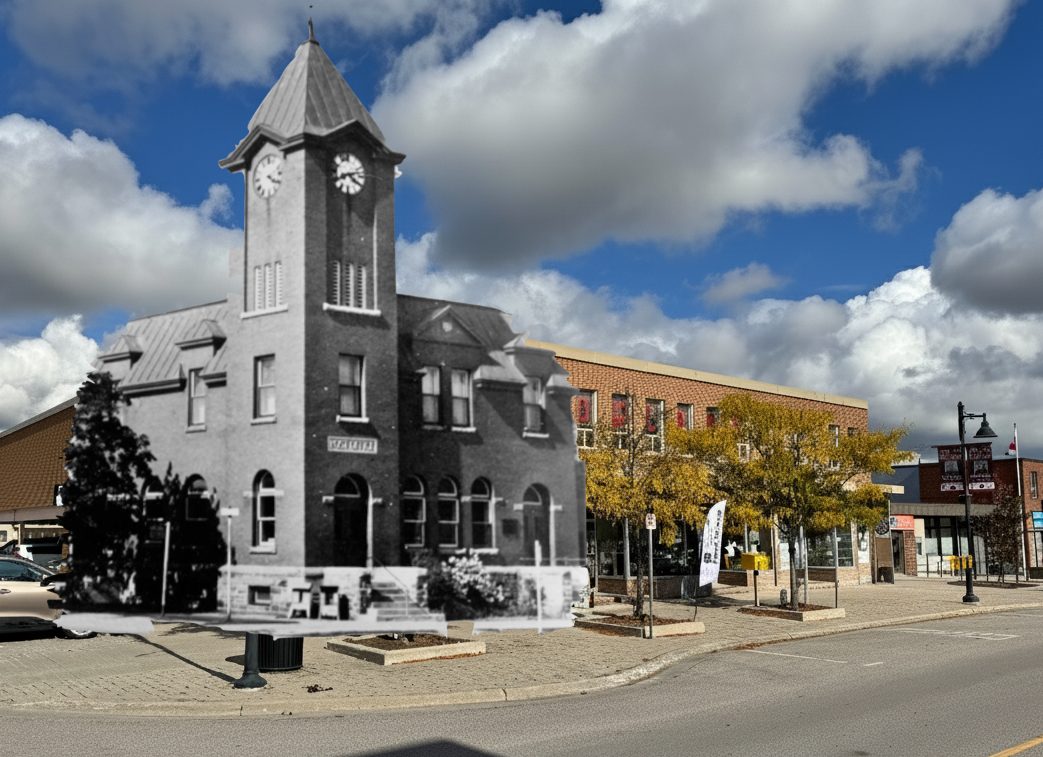
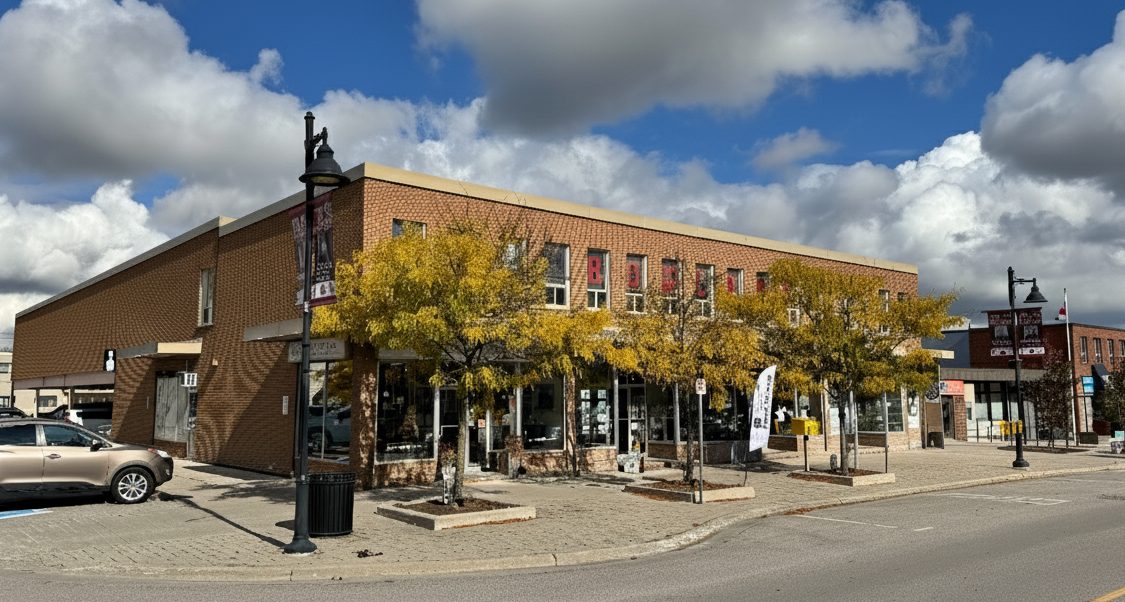
At first glance, the corner of Brock Street West and Spruce Street may look like just another busy intersection in downtown Uxbridge — but this spot has seen more than a century of change, growth, and community life. From a grand department store to the old post office, a bowling alley, and now a mix of thriving local businesses, this corner has always been at the heart of town.
.
Photo courtesy of www.scugogheritage.com
William Henry’s Grand Department Store (1885–1902)
The story begins in 1885, when William Henry built an impressive structure on this very corner to house his department store. The interior was said to be patterned after Simpson’s in Toronto, bringing a touch of big-city sophistication to small-town Ontario. Henry’s store quickly became a local landmark, and as business flourished, he expanded the block to the east.
For nearly two decades, it stood as one of Uxbridge’s most impressive commercial buildings — a symbol of progress and prosperity in a growing community. Sadly, that grandeur was short-lived. In 1902, a devastating fire destroyed the building, erasing one of the town’s early architectural gems.
.
Photo courtesy of Uxbridge The First 100 Years, by J. Peter Hvidsten
.
The Old Uxbridge Post Office (1911–1971)
Almost a decade later, the site would take on new life. Around 1911, construction began on the Uxbridge Post Office, a handsome stone and brick building that took three years to complete and was officially opened in 1914. For more than half a century, this post office was a cornerstone of the community — a place where neighbours crossed paths, mail arrived from afar, and town life unfolded daily.
In 1969, the Town of Uxbridge purchased the old post office from the federal government. However, in a controversial move, the town sold it just a year later, along with two other municipally owned properties. The building was demolished in 1971, paving the way for a new commercial complex that reflected the modernization of the era.
.
Uxbridge Post Office – Photo courtesy of www.scugogheritage.com
Uxbridge Post Office – Photo courtesy of www.scugogheritage.com
.
The Modern Era — Bowling, Business, and Community
The new building that replaced the post office was designed with versatility in mind. It featured five business spaces on the main floor, a bowling alley and arcade upstairs, and parking underneath — a forward-thinking layout for its time.
Over the years, these storefronts have been home to a number of well-remembered Uxbridge businesses. For many longtime residents, a few stand out in particular:
Evans Fine Jewellery & Gift Shoppe, located right on the corner, sparkled with timeless pieces and gifts for every occasion.
J.B. Variety, the classic go-to convenience store for generations of Uxbridge kids — and still proudly serving the community today.
Uxbridge Electronics, once located where Coldwell Banker R.M.R. Real Estate now operates, was the place to go for televisions, stereos, and all the latest gadgets. Many households in town bought their entertainment systems from Bob Jamieson, who became a familiar face to countless customers.
In the 1980s and 1990s, Uxbridge Electronics also became the place to rent movies — first on the short-lived RCA VideoDisc (yes, that was a thing — look it up, kids!) and later on Betamax andVHS tapes. Many a neighbourhood birthday party or family movie night began with a trip to that very store.
Upstairs, the bowling alley was a lively gathering spot for birthday parties, league nights, and evenings out with friends. It was a beloved part of the Uxbridge social scene for decades until it sadly closed in 2024, marking the end of another era for this well-known building.
.
Today’s Corner — A Blend of Past and Present
Today, the building continues to serve the community, housing a vibrant mix of local businesses:
Though the architecture and occupants have changed, the spirit of this corner remains the same — a place of connection, commerce, and community. From William Henry’s elegant department store to the familiar hum of the post office, the laughter from the bowling alley, and the modern mix of today’s shops and offices, this intersection tells a story of Uxbridge’s enduring evolution.
.
.
.
A Corner Through Time
This corner has seen more than just buildings rise and fall — it has witnessed the life of Uxbridge itself unfold. Each new chapter adds to the town’s tapestry, reminding us that history isn’t just found in museums or books — it’s right here, built into the streets we walk every day.
The above photo courtesy of Uxbridge The Good Old Days By J. Peter Hvidsten shows what the theatre looked like in 50’s
History of the Roxy Theatre
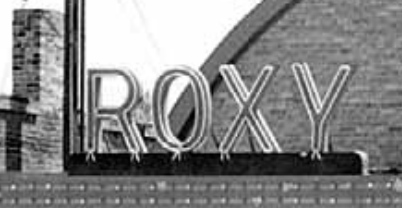
The quonset-style building was originally built in 1949 at the corner of Brock Street and Toronto Street. It opened as the RIO Theatre and in 1951 the name was changed to the ROXY when the Theatre Amusement Company purchased it. In the 1970’s the theatre was closed and then reopened as a drug store. All of our youth we remember it as a drug store. Half of the building was a drug store/pharmacy and the other half was a souvenir/gift store. Not sure of the year but the outside was used in a Guardian Pharmacy Christmas commercial. First there was the excitement of watching them film a snowy commercial during the summer months, and then watching it on TV.
The above photo courtesy of the Uxbridge Times-Journal shows the building after it was renovated and converted to Davie Pharmacy in the 1970’s
Reopening of the Roxy
The entire building was renovated, restored and reopened again as The Roxy Theatre on December 13th 1996. Until it was reopened as a theatre we would have to travel to Oshawa, Newmarket or Pickering to watch a movie. Now thanks to Cathy and Mark Christoff, Uxbridge residents could watch first run movies on two different screens with state-of-the-art digital projection and sound equipment all while enjoying movie theatre popcorn and being surrounded by movie nostalgia.
This housing report for Uxbridge includes the number of new listings, average list price, number of properties sold, average selling price, average days on market and average asking price to selling price ratio for all property types within the Township of Uxbridge


 Facebook
 X
X
 Pinterest
 Copy Link